Natural cleaning products aren’t always safe for kids and pets, nor are all natural ingredients effective against bacteria. You can’t replace chemical cleaners with natural ones for every job, and many products labeled “natural” aren’t trustworthy. While essential oils have their benefits, they’re not the ultimate solution. Plus, don’t assume all surfaces are safe for natural cleaners. If you want to uncover more myths about natural cleaning, there’s plenty more to explore!
Natural Cleaners Are Always Safe for Kids and Pets
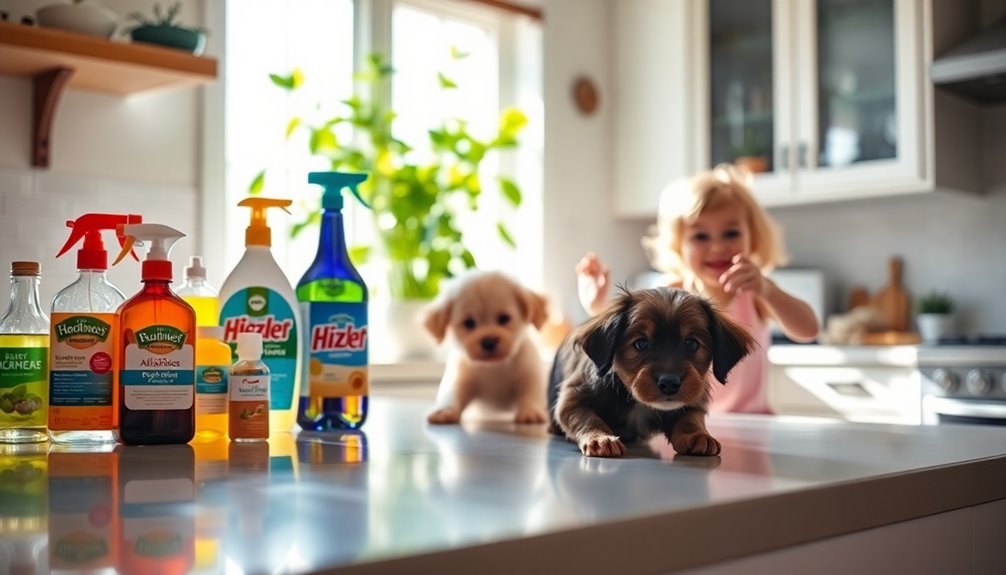
While many people assume that natural cleaners are completely safe for kids and pets, this isn’t always the case. You might think that because a product is labeled “natural,” it guarantees safety.
However, some natural ingredients can still be harmful, especially during child-pet interactions. For example, essential oils can be irritating or toxic to pets and young children if ingested or improperly used. Always check the ingredient list and research each component’s safety.
Natural ingredients aren’t always safe; essential oils can be toxic to kids and pets if misused. Always check ingredient safety.
Even seemingly harmless substances like vinegar can pose risks when used inappropriately. So, don’t let the “natural” label fool you.
Prioritize natural ingredient safety by being vigilant and informed about the products you choose, ensuring a healthier environment for both your kids and pets. Additionally, some natural cleaning products may not provide the same level of cleaning efficacy as plant-based ingredients found in many commercial options.
All Natural Ingredients Are Effective Against Bacteria
Just because an ingredient is natural doesn’t mean it’s effective against bacteria. Many people assume that natural cleaners boast high natural efficacy, but that’s not always the case.
Ingredients like vinegar and baking soda might’ve some antibacterial properties, but they often fall short against resilient bacteria. This is particularly true for strains that have developed bacterial resistance.
If you rely solely on natural ingredients, you mightn’t eliminate harmful pathogens as effectively as you think. It’s essential to understand that while some natural substances can help with cleaning, they may not provide the same level of disinfection as chemical alternatives. Using white vinegar as a cleaner can help reduce bacteria, but it isn’t a guaranteed disinfectant for all pathogens.
Always research and choose your cleaning products wisely to guarantee a truly hygienic environment.
You Can Replace All Chemical Cleaners With Natural Ones
Many people believe that natural cleaners can completely replace chemical ones in their cleaning routines. While natural cleaners have their benefits, they also come with limitations.
For instance, they mightn’t tackle heavy-duty grime or persistent stains as effectively as chemical cleaners. You may find that certain surfaces require the powerful action of chemical-based products to achieve the desired results.
Chemical cleaner advantages include faster action and a broader range of effectiveness against various contaminants.
It’s important to assess your specific cleaning needs and recognize that, in some cases, a combination of natural and chemical cleaners will give you the best results.
Embracing both options allows you to clean effectively while being mindful of your health and the environment.
Natural Cleaners Are Always Eco-Friendly
Just because a cleaner is labeled as natural doesn’t mean it’s eco-friendly.
You need to evaluate where the ingredients come from and how the packaging affects the environment.
It’s important to look beyond the label and think about the overall impact of your cleaning choices. Additionally, some natural ingredients, like hydrogen peroxide, can be highly effective for cleaning without the toxic effects of traditional bleach.
Ingredient Sourcing Matters
While you might assume that all natural cleaners are eco-friendly, the truth is that ingredient sourcing plays a significant role in their environmental impact.
It’s essential to take into account ingredient purity and sourcing transparency when choosing your cleaning products. Not all natural ingredients are harvested sustainably; some may harm ecosystems or communities in the process.
For instance, a cleaner advertised as “natural” could contain ingredients sourced from regions with questionable labor practices or environmentally damaging methods.
To make informed choices, always research the brands you support. Look for companies that openly share their sourcing practices and prioritize sustainable, ethically sourced ingredients.
This way, you guarantee that your cleaning products aren’t just natural but truly eco-friendly as well.
Packaging Impact Counts
Even if a cleaner is labeled as “natural,” it doesn’t automatically mean its packaging is eco-friendly. You need to look beyond the ingredients and consider packaging sustainability.
Many products come in plastic containers that contribute to environmental harm, regardless of how pure the formula is. Eco-friendly materials, such as recycled or biodegradable options, play a vital role in reducing your overall environmental footprint.
When you choose cleaning products, make sure to check for certifications or labels indicating environmentally responsible packaging.
Essential Oils Are the Best Natural Cleaning Agents
You might think essential oils are the ultimate natural cleaning agents, but their antimicrobial properties can be quite limited. Relying on them alone often won’t cut through tough grime or kill all germs. It’s important to understand their role in cleaning and consider using them alongside other effective methods, such as incorporating non-toxic cleaners for enhanced disinfecting.
Limited Antimicrobial Properties
Though many believe that essential oils are the ultimate natural cleaning agents, their antimicrobial properties can be surprisingly limited. You might think these potent oils can tackle all germs, but studies show their efficacy isn’t as robust as advertised.
Many essential oils do have some antimicrobial activity, yet this doesn’t guarantee they’ll eliminate all bacteria or viruses effectively. In fact, the antimicrobial limits of essential oils can leave you vulnerable to harmful pathogens.
When you rely solely on these oils for cleaning, you might be overlooking the need for more powerful disinfectants. Understanding these limitations is vital for maintaining a clean and safe home.
Don’t underestimate the importance of combining cleaning methods for maximum effectiveness.
Not Always Effective Alone
While essential oils are often touted as the best natural cleaning agents, they’re not always effective on their own. You might find that their natural cleaner limitations mean they struggle against tougher stains and grime.
For instance, a few drops of tea tree oil may freshen up a surface, but it won’t tackle sticky residues like commercial cleaners can.
When you make an effectiveness comparison, you’ll see that essential oils can be great as part of a cleaning routine but may need to be combined with other cleaning agents for ideal results.
Relying solely on them can leave you disappointed, so consider using a mix of natural and traditional products to achieve the clean you want.
Vinegar Can Clean Everything Effectively
Although vinegar is often touted as a universal cleaner, it doesn’t work effectively on all surfaces or stains. You might find vinegar’s effectiveness impressive for cutting through grime and odors, but it has cleaning limitations.
For instance, vinegar can damage natural stone surfaces like granite and marble due to its acidity. It also fails to sanitize effectively against certain germs and bacteria, leaving you with a false sense of cleanliness. In fact, while vinegar contains 4-6% acetic acid, its antimicrobial properties may not suffice against all pathogens.
Additionally, while vinegar can tackle some stains, it’s not a magic solution for grease or heavy-duty messes. Instead of relying solely on vinegar, consider using it alongside other cleaning agents for better results.
Natural Cleaners Are More Expensive Than Chemical Options
Many people believe that opting for natural cleaners will save them money in the long run, but that’s not always the case. When you do a price comparison, you might find that some natural options can be pricier than their chemical counterparts.
While it’s true that some natural brands offer high-quality products, others may not provide the same cleaning power as chemicals, leading you to use more product to achieve the desired results. This can affect your budget considerations considerably.
Additionally, if you opt for organic or specialty natural cleaners, you may end up spending even more. So, before you jump on the natural bandwagon, think carefully about what fits your budget and cleaning needs best. Furthermore, many eco-friendly brands like Thrive Market emphasize biodegradable and cruelty-free products, which might justify a higher price point for those concerned with sustainability.
Homemade Cleaners Are Always Better Than Store-Bought
Just because homemade cleaners are often touted as the superior choice doesn’t mean they always outshine store-bought options.
While you might love the idea of crafting your own solutions, consider the homemade cleaner effectiveness. Many store-bought products are rigorously tested for safety and efficiency, ensuring they tackle tough messes quickly.
Plus, store-bought convenience can’t be overlooked; they save you time and effort, especially when you’re in a hurry.
What’s more, some homemade recipes can lack the potency needed for specific tasks. Time-saving techniques allow you to quickly address messes without sacrificing cleanliness.
Don’t get me wrong—there are great homemade cleaners out there—but it’s essential to evaluate your cleaning needs.
Balancing effectiveness with convenience is key to achieving a clean home without the hassle.
Does Natural Cleaning Take Longer to Work?
When you switch to natural cleaning products, you might wonder if they take longer to show results. The truth is, natural cleaners can be just as effective as their chemical counterparts when used correctly.
While some people perceive that natural options require more time, it’s often about the technique rather than the product itself. For instance, allowing a natural cleaner to sit for a few minutes can enhance its cleaning effectiveness. Additionally, using essential oils in your natural cleaning solutions can boost their antibacterial properties and improve scent, making the cleaning process more enjoyable.
In many cases, you won’t sacrifice time efficiency; you may even find that you need less scrubbing or repeated applications. Ultimately, with the right approach, natural cleaning can be both quick and effective, debunking the myth that it takes longer to work than traditional cleaners.
Do Natural Cleaners Have Strong Enough Scents to Clean?
How can a cleaner effectively eliminate odors without overpowering scents? Many people believe that strong scents indicate a cleaner’s efficacy, but that’s a myth.
Natural cleaners often use essential oils, which can provide pleasant fragrances without the harshness of synthetic chemicals. The key is balancing scent strength with cleaning efficacy. These cleaners can neutralize bad odors while leaving behind a subtle, fresh scent. You don’t need overpowering fragrances to achieve a clean space; in fact, a lighter scent can mean fewer artificial additives. Additionally, incorporating essential oils into your cleaning routine can enhance not only the aroma but also the cleaning properties of your solutions.
Do You Need to Use More Natural Cleaner for Tough Stains?
Ever wonder if you need to apply more natural cleaner to tackle tough stains? The answer isn’t always straightforward.
While it might seem logical to slather on more product, effective cleaning methods often rely on technique over quantity. Instead of heaping on the cleaner, try letting it sit for a few minutes. This allows the natural ingredients to break down the stain without wasting product.
Additionally, combining natural cleaners can enhance their power—think vinegar and baking soda for a potent duo. Eco-friendly products often utilize non-toxic ingredients that can be just as effective against tough stains. Remember, using more cleaner doesn’t necessarily mean you’ll achieve better results.
Focus on the right methods, and you’ll find that less can be more, even for those tough stains that seem impossible to remove.
Are Natural Cleaning Products Less Effective for Heavy-Duty Jobs?
Natural cleaners can be surprisingly effective, even for heavy-duty jobs, but their performance often depends on the specific task at hand. Many people assume that natural alternatives can’t compete with traditional products, but that’s not always true.
For instance, vinegar and baking soda can power through tough grease and stains when used correctly. However, for some heavy-duty effectiveness, you might need to combine different natural ingredients or let them sit longer to break down the grime.
It’s crucial to know what you’re tackling and choose the right natural cleaner. Don’t shy away from experimenting with various natural alternatives; you might find that they work just as well, if not better, than their chemical counterparts for those intense cleaning challenges.
Are All Labels That Say “Natural” Trustworthy?
When you see a label that says “natural,” it mightn’t always mean what you think.
Misleading marketing claims and a lack of regulation can make it tough to trust these products.
Plus, ingredient transparency issues can leave you wondering what’s really in the cleaner you’re using.
Misleading Marketing Claims
While you might assume that products labeled as “natural” are safe and environmentally friendly, many misleading marketing claims blur the lines between genuine and deceptive.
Companies often use clever marketing tactics to create an illusion of safety, making you believe their products are better for you and the planet. Just because a label boasts about being “natural” doesn’t mean it’s free from harmful chemicals or environmental impact.
Always check ingredient lists and do your research to differentiate between truly eco-friendly options and those using misleading claims.
Remember, the absence of regulation means companies can exploit terms like “natural” without accountability, leaving you to navigate a sea of confusion.
Stay informed and skeptical to make better choices.
Lack Of Regulation Standards
Misleading marketing claims can leave consumers confused about what “natural” really means.
Unfortunately, there’s a lack of regulatory oversight when it comes to cleaning products labeled as “natural.” This absence of strict safety standards means companies can use the term freely, often without any real accountability.
You might think a product labeled “natural” is safer or healthier, but that’s not always the case. Without consistent definitions or regulations, it’s tough to trust those labels.
You could be buying products that contain harmful chemicals, even if they’re marketed as eco-friendly. Always do your research and look for certifications that indicate adherence to safety standards, ensuring you choose truly safe cleaning solutions for your home.
Ingredient Transparency Issues
Though many products boast “natural” ingredients, you shouldn’t assume that all labels are trustworthy. Ingredient sourcing is often vague, leaving you in the dark about where those “natural” components actually come from.
Some companies may highlight one or two good ingredients while hiding harmful ones behind generic terms. Labeling accuracy can vary greatly; just because something says “natural” doesn’t mean it’s free from synthetic additives or harmful chemicals.
Always scrutinize the entire ingredient list instead of relying solely on marketing claims. Look for brands that prioritize transparency and provide detailed information about their sourcing practices.
Educating yourself about what truly qualifies as “natural” can help you make safer, more informed choices for your home.
Can You Use Natural Cleaners on All Surfaces?
When you’re considering natural cleaners, it’s important to know that not all surfaces are created equal.
While many natural cleaners boast cleaner versatility, this doesn’t mean they’re suitable for every material. For instance, vinegar might work wonders on countertops, but it can damage marble and granite due to its acidity.
Similarly, baking soda is great for scrubbing but may scratch delicate finishes. Always check for surface compatibility before using a cleaner.
To keep your surfaces safe, test a small, inconspicuous area first. Remember, just because a cleaner is natural doesn’t mean it’s universally safe.
Conclusion
In the domain of cleaning, the myth of “natural” products shines like a polished apple—tempting, but often misleading. Just as not every bright fruit is safe to eat, not every natural cleaner is effective or safe. By peeling back the layers of these misconceptions, you can make informed choices that truly benefit your home and environment. Remember, knowledge is your best cleaning tool; it cuts through the grime of misinformation and leads you to a healthier, cleaner space.