Last updated: · By Megan Hart
Kid-friendly cleaning products are cleaners that keep exposure low when they are chosen carefully, used as directed, and stored out of reach. For most families, that means reading full ingredient lists, using disinfectants only when disinfecting is actually needed, and keeping every bottle away from children. The New York State Department of Health notes that millions of people are unintentionally poisoned each year, and children under six face the greatest risk. This guide explains what to look for, how common options compare, and what to do in an emergency.
Key Takeaways
- Household cleaning products such as bleach, drain decloggers, and glass sprays accounted for about 11 percent of poison control center calls for children under 6 in 2017.
- Many disinfectants are toxic when swallowed, so the Centers for Disease Control and Prevention (CDC) advises keeping them out of children’s reach.
- Mixing chlorine bleach with ammonia-based cleaners can cause serious injury or death, so cleaners should not be combined unless the labels say it is safe.
- Words like ‘natural’ and ‘non-toxic’ are marketing terms, so check the ingredient list and label directions instead of relying on them alone.
- In the United States, Poison Help can be reached at 1-800-222-1222, and that number should be saved in every phone at home.
What Makes a Cleaning Product Kid-Friendly?
A kid-friendly cleaning product has a complete ingredient list, is used exactly as its label directs, and is stored where children cannot reach it. No single federal standard defines the phrase ‘kid-friendly,’ so a product’s front label alone does not tell you much about its safety.
Which Label Details Matter Most?
Use this checklist when you shop:
- A full ingredient list, not just a claim such as ‘plant-based’
- The EPA Safer Choice label, which indicates the ingredients were reviewed against criteria for human and environmental health
- An EPA registration number on any product that claims to disinfect or kill germs
- Child-resistant caps and original packaging that is not easily confused with food or drink
- Clear signal words, first aid instructions, and any warnings about mixing with other products
A Safety Data Sheet (SDS) is a document that lists a product’s hazards, handling steps, and first-aid information. Many manufacturers post SDS files on their websites, and reading one is the most detailed way to check a product before you buy it.
Why Are Young Children at Greater Risk?
Young children are at greatest risk because they explore by putting objects in their mouths and spend more time close to floors and low surfaces. A cleaner that smells pleasant or looks like a juice bottle can be especially tempting to a toddler. Children under six account for a large share of household chemical exposures.
According to a Consumer Reports guide on protecting kids from household poisons, cleaning products such as bleach, drain decloggers, and glass sprays made up about 11 percent of poison control center calls for children under 6 in 2017. That figure shows how common these exposures are, but it does not measure how dangerous each product is or how often a given product is used.
How Do Common Cleaning Products Compare for Families?
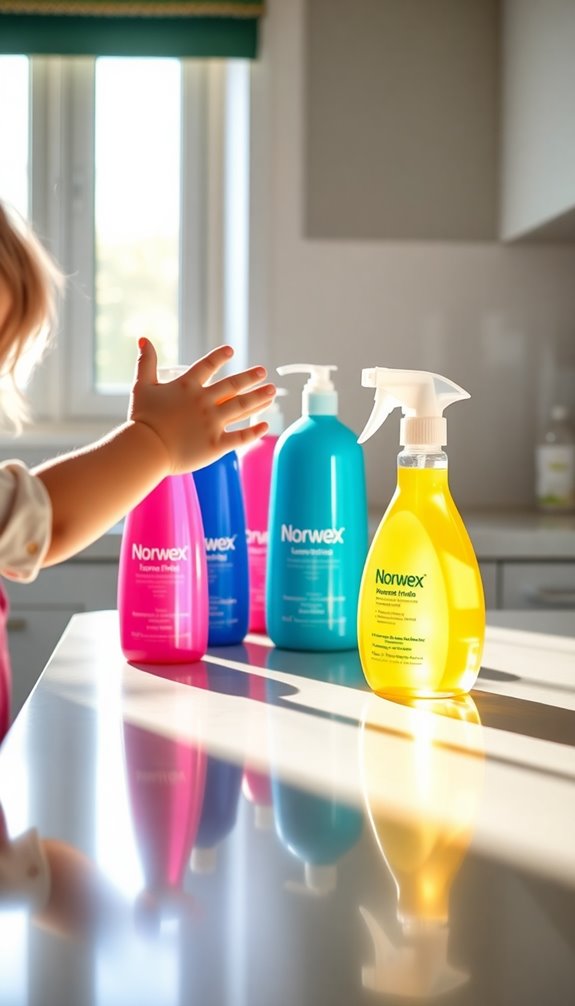
Plant-based sprays, water-only microfiber cloths, and EPA-registered disinfectants serve different jobs, and each carries different kid-safety considerations. The table below compares six common categories by use, label checks, and main concern.
| Product type | Common use | What to check on the label | Main kid-safety concern |
|---|---|---|---|
| Plant-based all-purpose spray | Counters, tables, and high-touch surfaces | Full ingredient list and any Safer Choice label | Still a concentrated liquid, so keep it closed and stored up high |
| Water-only microfiber cloths | Dusting and wiping glass and hard surfaces | Care instructions and whether a cleaning solution is also required | Low chemical exposure, but results depend on technique and cloth condition |
| EPA-registered disinfectant | Disinfecting after illness or raw meat spills | EPA registration number, dilution, and contact time | Many are toxic if swallowed, so store them out of reach and follow rinse directions |
| Toilet or tub cleaner | Bathroom fixtures and tile | Acid or bleach warnings and mixing instructions | Acidic and bleach products can burn skin and eyes, so keep children out of the room while in use |
| Plant-based wipes | Quick wiping of toys and high-touch items | Whether the label allows use on toys or only on hard surfaces | Wipes are not a substitute for handwashing, and children should wash hands after handling them |
| Vinegar and water | Light cleaning of glass and some surfaces | Not an EPA-registered disinfectant | Can damage natural stone and some finishes |
Are ‘Natural’ Brand-Name Cleaners Safer?
Not automatically. Plant-derived and fragrance-free products can still irritate skin or eyes, and essential oils can cause reactions in some people. Some essential oils are also harmful to cats, so pet households should check labels carefully.
Several brands are often chosen for family homes. Seventh Generation offers all-purpose and disinfecting sprays, Mrs. Meyer’s uses plant-derived ingredients and essential oils, Method publishes ingredient information for its cleaners, Dapple sells plant-based wipes, Norwex sells microfiber cloths designed for water-based cleaning, and Blueland offers refillable products to reduce packaging waste. Product formulas change, so verify the current label and ingredient list before you buy. For more options, see these non-toxic green cleaners for homes with pets and kids.
Is a DIY Vinegar and Water Cleaner Safe for Kids?
A vinegar and water solution is a low-toxicity option for light cleaning, but it is not a registered disinfectant. A common mix is equal parts distilled white vinegar and water in a clearly labeled spray bottle. Because it is acidic, it is a poor choice for natural stone such as marble and granite, and it can dull some sealed finishes.
- Test any new surface in a hidden spot before spraying the whole area.
- Label the bottle clearly, and store it out of reach like any other cleaner.
- Adding essential oils does not make the solution a disinfectant, and it can add irritation risk.
- Never mix vinegar with bleach, because the combination releases chlorine gas.
Which Cleaning Combinations Should You Avoid?
Never combine bleach with ammonia-based cleaners, and never mix bleach with acidic cleaners such as vinegar or some toilet cleaners. The CDC’s guidance on cleaning and disinfecting early care and education settings warns that mixing chlorine bleach with ammonia-based cleaners can cause serious injury or death. Cleaners should not be combined unless the labels say it is safe.
If you are unsure which products are compatible, read which cleaning products should never be mixed before you clean. Rinse surfaces and ventilate between products, and never reuse a bottle for a different chemical.
How Should You Store and Use Cleaners Around Kids?
Store every cleaner in a locked cabinet or on a high shelf, keep it in its original container, and use it only when children are out of the room. The CDC’s guidance for cleaning and disinfecting homes and schools states that many disinfectants are toxic when swallowed, which makes storage one of the most important safety habits.
- Store cleaners in a locked cabinet or high shelf, including under-sink spaces, which are often reachable by toddlers.
- Keep products in their original labeled containers, and never pour cleaner into food or drink bottles.
- Use the lowest amount that works, and follow the label’s dilution and contact time instructions.
- Ventilate the room and keep children out until surfaces are dry or rinsed as directed.
- Rinse food-contact surfaces when the label requires it.
- Close caps tightly and return products to storage right after use.
If children help with chores, a kid-friendly cleaning caddy with only the supplies you have chosen to keep accessible can teach good habits while limiting access to stronger products.
What Should You Do If a Child Swallows or Touches a Cleaner?
Call Poison Help at 1-800-222-1222 right away, or call 911 if the child is unconscious, having a seizure, or having trouble breathing. Poison specialists can give product-specific guidance and tell you whether the child needs to be seen in person. This article is general information and does not replace advice from a poison center, pediatrician, or emergency team.
- Move the child away from the product and make sure the area is safe for you to act.
- Check the container for the product name, ingredients, and approximate amount involved.
- Do not induce vomiting or give anything by mouth unless a medical professional tells you to.
- For skin or eye contact, rinse with water for the time the label directs, and call for advice.
- Keep the container with you when you call or go to the hospital.
Frequently Asked Questions
Are plant-based cleaning products safe for toddlers?
Plant-based products can be a better choice than harsh chemicals, but they are not automatically safe to swallow or touch. Read the label, follow the directions, and store every cleaner out of reach. If a toddler swallows any cleaner, call Poison Help at 1-800-222-1222.
Is vinegar safe to use around children?
Diluted vinegar is low in toxicity for light cleaning, but it can irritate eyes and damage some surfaces. It is not an EPA-registered disinfectant, so do not rely on it to kill germs. Never mix it with bleach.
Can I wipe toys with disinfectant wipes?
Only if the label allows use on toys or the item type you are cleaning. Follow the contact time and let the surface air dry or rinse as directed. Have children wash their hands afterward, and do not let them mouth wiped items until they are dry.
Should I keep cleaners in their original bottles?
Yes. Original containers carry the ingredient list, warnings, and first-aid information you may need in an emergency. Transferred cleaners can be mistaken for drinks, which is one of the most common causes of accidental exposure.
What if my child breathed in cleaning fumes?
Move the child to fresh air right away and call Poison Help at 1-800-222-1222. Call 911 if the child has trouble breathing, chest pain, or is hard to wake. Do not return to the room to clean until it has been fully ventilated.
How often should I check my cleaning supplies?
Check your supplies every few months for expired or unlabeled containers and for products you no longer use. Discard unlabeled bottles safely according to local guidance, and never leave old products within a child’s reach.
Conclusion
Kid-friendly cleaning products are the ones you choose carefully, use as directed, and store out of reach. Read full ingredient lists, use disinfectants only when needed, never mix cleaners, and save Poison Help’s number at 1-800-222-1222. If you have questions about a specific child or exposure, talk with your pediatrician or a poison specialist.
More on Kid-Friendly Cleaning Products
- 16 Cleaning Hacks for Homes With Toddlers Into Everything
- How to Create a Kid‑Friendly Cleaning Caddy They’ll Actually Use
- The Ultimate Guide to Cleaning Kids’ Rooms and Playrooms
Related guides: 20 Pet‑Safe Cleaning Products You Can Use With Confidence · Top 10 Natural Cleaning Products for a Chemical-Free Home · 7 Best Disinfectants for Bathroom Surfaces
Free tools: Cleaning Products You Should Never Mix
Always follow the product label, test on a hidden area first, and never mix cleaning products such as bleach and ammonia. Read our safety disclaimer and editorial policy.
2 Replies to “Top 10 Kid-Friendly Cleaning Products for a Safe Home”